Peas: three to one
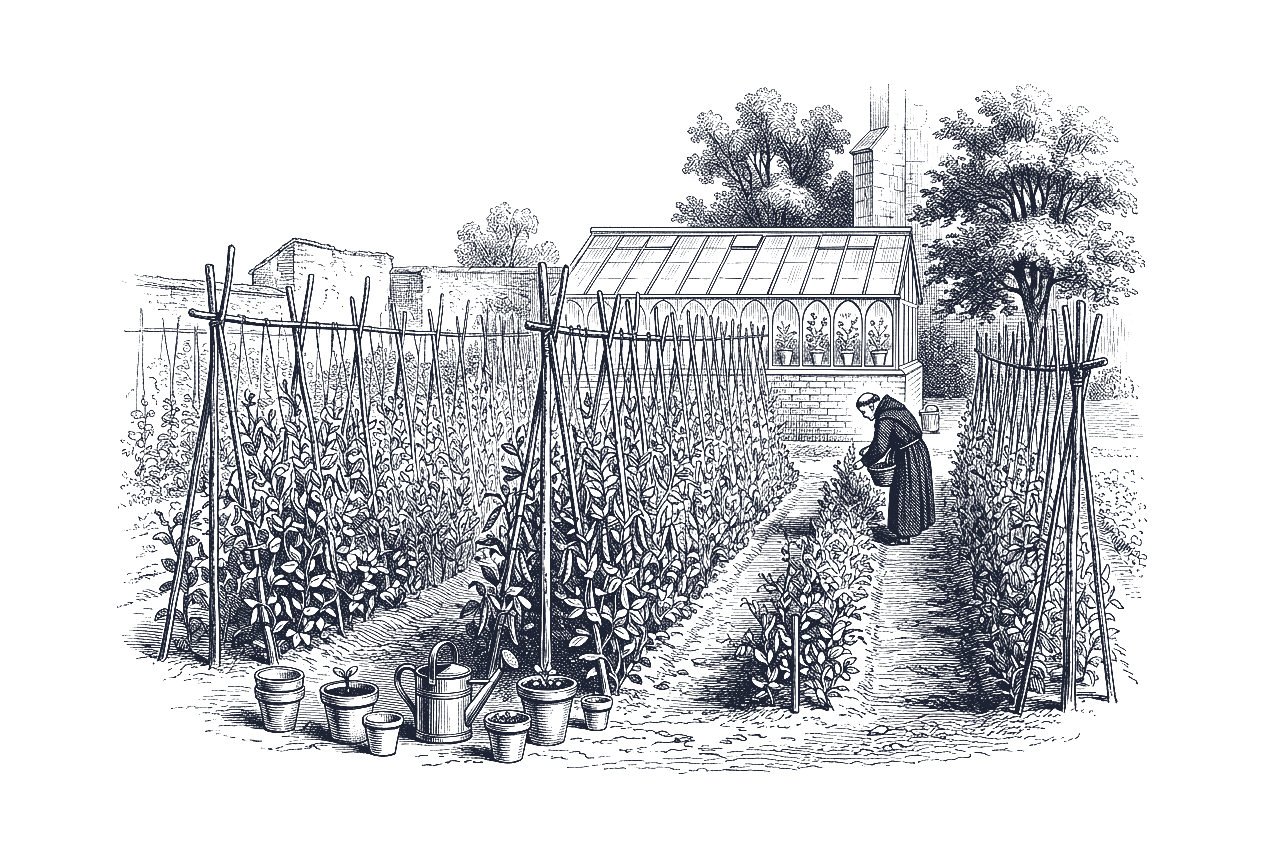
Gregor Mendel was a monk in Brno. In the monastery garden he grew peas: thousands of them, for eight years.
Everyone knew that children look like their parents. Nobody knew the rule. Most people thought the parents' traits simply blend, like mixing paint.
What is a monohybrid cross?
A monohybrid cross follows one trait through two generations. Mendel crossed a pea variety that always gave yellow peas with one that always gave green peas. These starting plants are the parents, or P generation. Their seeds are the first generation of children (F1), and the seeds of the F1 plants are the grandchildren (F2).
The result
All F1 peas were yellow. Then, when the F1 plants pollinated themselves, about one pea in four was green again. Mendel counted 6,022 yellow and 2,001 green peas: 3.01 to 1.
The explanation: two copies of each gene
Every plant carries two copies of the colour gene, one from each parent. We write the yellow version as Y and the green version as y. A pure yellow plant is YY, a pure green one is yy. Each pollen grain or egg cell gets just one copy, chosen by chance. This is the law of segregation.
The F1 children all got Y from one parent and y from the other, so they are Yy. One Y is enough to make a pea yellow: yellow is dominant, green is recessive.
Why 3 to 1
When two Yy plants make seeds, the pollen is half Y, half y, and so are the egg cells. A Punnett square lists all four meetings, each equally likely: YY, Yy, yY and yy. Three of the four contain at least one Y and are yellow; only yy is green. So the grandchildren come out 3 yellow to 1 green, and the genotypes 1 YY : 2 Yy : 1 yy.
How Mendel checked it
If the idea is right, one in three yellow grandchildren is pure YY and two in three are hidden carriers Yy. Mendel grew 519 yellow F2 peas into plants: 166 gave only yellow peas and 353 gave both colours, close to 1 to 2. You can repeat this test in the "On your own" mode.
What they found
Traits do not blend. Each plant carries two copies of a "factor" for colour and passes one of them, by chance, to every seed. Today we call these factors genes.
A trait can hide for a generation (green) behind a dominant one (yellow) and come back in about one in four grandchildren: each grandchild has a 1 in 4 chance.
Why it matters today
Two healthy parents can both carry a hidden copy of a gene for a disease such as cystic fibrosis. Each of their children then has a 1 in 4 chance of getting two copies. Carrier tests and genetic counselling work with exactly Mendel's arithmetic.