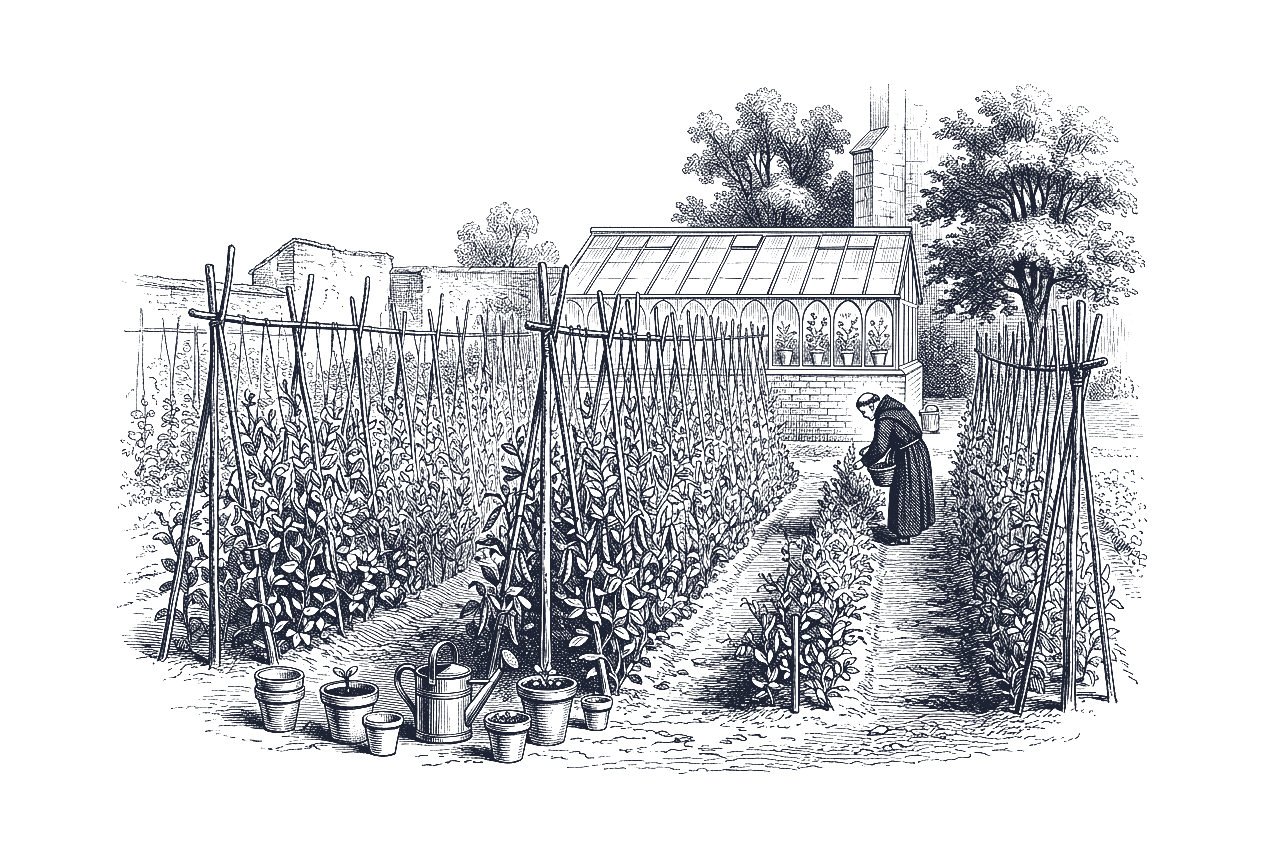
Peas: two traits at once
Mendel then followed two traits at the same time: the colour of the pea (yellow or green) and its shape (round or wrinkled).
If traits are handed down as a package, a yellow-round parent should give only yellow-round or green-wrinkled grandchildren.
What is a dihybrid cross?
A dihybrid cross follows two traits at once. Mendel crossed peas that were yellow and round (YYRR) with peas that were green and wrinkled (yyrr). All F1 peas were yellow and round (YyRr), because yellow and round are both dominant.
The 9 : 3 : 3 : 1 ratio
In the F2 Mendel found 315 yellow-round, 108 green-round, 101 yellow-wrinkled and 32 green-wrinkled peas. That is close to 9 : 3 : 3 : 1 out of every 16. Two of the four kinds, green-round and yellow-wrinkled, had never been seen in the grandparents.
Independent assortment
Look at one trait at a time and the old rule is still there: yellow to green is about 3 to 1, and round to wrinkled is about 3 to 1. The two genes are handed out separately, like two coins tossed at the same time. This is the law of independent assortment.
An F1 plant (YyRr) makes four kinds of pollen and egg cells in equal numbers: YR, Yr, yR and yr. A 4 × 4 Punnett square has 16 equally likely squares: 9 contain at least one Y and one R, 3 have R but no Y, 3 have Y but no R, and 1 is yyrr.
A shortcut
Because the genes are independent, you can multiply: the chance of a green-wrinkled pea is 1/4 (green) × 1/4 (wrinkled) = 1/16, and of a yellow-round pea 3/4 × 3/4 = 9/16.
When it does not work
Genes that sit close together on the same chromosome tend to travel together and break the 9 : 3 : 3 : 1 rule. That discovery led to the first gene maps (see Sturtevant's experiment).
What they found
Colour and shape are inherited independently. Each one splits 3 to 1 on its own, so together they give 9 : 3 : 3 : 1, including two combinations no ancestor had.
This is why brothers and sisters can be so different: every child gets a fresh shuffle of the parents' genes.
Why it matters today
Plant breeders use exactly this shuffle to combine, say, the yield of one wheat variety with the disease resistance of another, and then pick the rare plants that breed true.